
The Most Important Decisions in Perimeter Security Are Made Before InstallationFour Questions Every Security Team Should Ask
- June 19, 2026
- Posted by: Eric Heller
- Category: Insights
After more than two decades helping organizations protect critical infrastructure, we’ve learned something that may sound surprising:
Most perimeter security failures are purchased, not installed.
When a perimeter detection system produces excessive nuisance alarms, leaves coverage gaps, creates operational headaches, or fails to deliver the expected return on investment, the root cause is often not the installation itself. More often, the problem began much earlier—during the evaluation process.
The challenge is that today’s buyers face a growing number of perimeter security technologies. Thermal cameras, radar systems, visible video analytics, fence-mounted sensors, fiber-optic detection, and other approaches all promise effective intrusion detection. Yet comparing them can be difficult because specifications alone rarely tell the whole story.
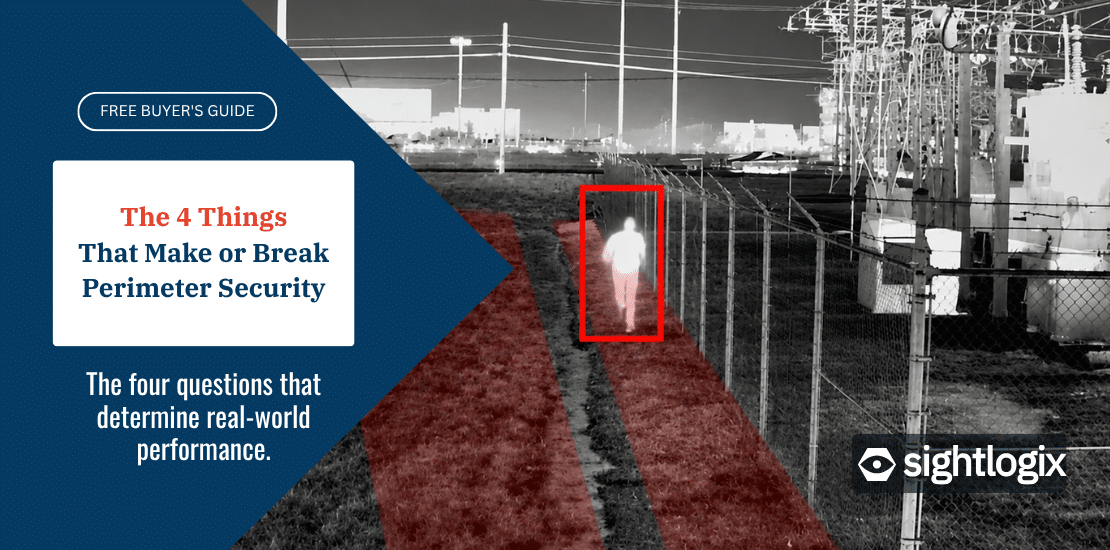
That’s why we created our Perimeter Security Buyer’s Guide: Four Questions Every Security Team Should Ask. Rather than focusing on product specifications, the guide examines four practical questions that often determine whether a perimeter security project succeeds or struggles after deployment.
The Problem with Comparing Specifications
When evaluating perimeter security systems, it’s natural to start with specifications. Detection range, camera resolution, analytics capabilities, sensor type, and communications options all seem like logical comparison points.
The problem is that specifications rarely tell the entire story.
A perimeter security system is ultimately judged by how it performs in the field. Can it reliably detect legitimate threats? Does it generate manageable alarm volumes? Can operators trust the alerts they receive? Will it provide effective protection without creating unnecessary operational burdens?
These questions are often far more important than the individual specifications listed on a datasheet.
Why Perimeter Security Projects Fall Short
In our experience, unsuccessful perimeter security projects often share similar characteristics.
The selected technology may not perform as expected under real-world environmental conditions. False alarms may become a daily frustration. Coverage assumptions may not align with actual site conditions. Infrastructure costs may exceed original estimates. Security personnel may find the system difficult to manage effectively.
None of these issues necessarily indicate that the technology itself is flawed. More often, they result from an evaluation process that focused on features rather than outcomes.
Organizations that begin with a clear understanding of their operational requirements tend to make better long-term decisions than those that focus exclusively on specifications or initial purchase price.
Four Questions That Matter Most
While every site has unique requirements, we’ve found that four questions consistently help organizations make more informed decisions when evaluating perimeter detection technologies.
1. How Effectively Does the System Detect Real Threats?
Detection performance remains the foundation of any perimeter security solution. However, effective detection is about more than achieving impressive range numbers under ideal conditions. The key question is how consistently the system performs in the actual environment where it will be deployed.
2. How Well Does the System Minimize Nuisance Alarms?
Excessive nuisance alarms can quickly undermine confidence in a security system. Wildlife, weather, shadows, moving vegetation, and other environmental factors all have the potential to generate unwanted alerts. Effective filtering and classification capabilities are critical to maintaining operator trust and system effectiveness.
3. What Is the True Cost of Deployment?
The cost of a perimeter security project extends well beyond the sensors themselves. Infrastructure, poles, power, communications, installation, maintenance, and ongoing operations all contribute to the total cost of ownership. Evaluating these factors early can prevent unpleasant surprises later in the project lifecycle.
4. How Easy Will the System Be to Operate?
A technically capable system that creates excessive workload for operators may never achieve its full potential. Ease of use, alarm presentation, event verification, integration with existing security platforms, and day-to-day management all play an important role in overall project success.
A Better Framework for Evaluating Perimeter Security Technologies
Security technologies continue to evolve. Artificial intelligence, advanced thermal imaging, video analytics, radar, and multisensor solutions continue to improve what organizations can achieve at the perimeter.
Yet the fundamentals of evaluating perimeter security systems remain remarkably consistent.
The most successful projects begin by defining the desired outcomes and then selecting technologies that can reliably achieve those objectives. Asking the right questions before a purchase decision is often the difference between a system that becomes a trusted security asset and one that creates ongoing operational challenges.
For organizations currently evaluating perimeter detection technologies, the Perimeter Security Buyer’s Guide: Four Questions Every Security Team Should Ask provides a practical framework for comparing solutions based on real-world performance, operational effectiveness, and long-term value.
Visit: https://beyondthespec.sightlogix.com or download the PDF here.